
Key Takeaways
- U.S. staffing firms face mounting pressure from talent shortages, volatile demand, high turnover, and rising operational costs.
- Offshore staffing has evolved from a cost-saving tactic into a strategic growth lever, enabling faster scaling and access to specialized global talent.
- Firms that offshore can reduce labor costs by 30–50% while improving time-to-hire and operational efficiency.
- Offshore teams allow staffing agencies to focus on core business functions and client relationships instead of administrative burdens.
- Real-world case studies, like Servantex, show that offshore staffing can deliver significant cost reductions while maintaining service quality.
As U.S. staffing firms grapple with the relentless pressures of fluctuating demands, escalating operational costs, and an increasingly competitive talent market, the urgency for innovative solutions has never been more critical.
Enter offshore staffing—a transformative approach that not only addresses these pressing challenges but also unlocks access to a global talent pool. In this article, we will explore how U.S. companies are leveraging offshore staffing to enhance efficiency, reduce costs, and secure a competitive edge in today’s dynamic landscape.
The Challenges Facing U.S. Staffing Firms
As U.S. staffing firms meet demand through offshore talent, they face growing pressure to adapt to workforce volatility, rising costs, and skill gaps. The current market conditions highlight several challenges that staffing firms must navigate:
- Fluctuating Demand for Talent: Staffing agencies often encounter rapid changes in client needs. Economic shifts, industry developments, and seasonal variations can lead to surges or declines in demand for particular skill sets. According to the U.S. Chamber of Commerce, ongoing labor shortages and workforce volatility continue to disrupt hiring capacity across multiple U.S. industries.
- Talent Shortages: The staffing industry continues to experience significant challenges in sourcing qualified candidates, with agencies feeling the strain of high demand. The U.S. staffing industry plays a critical role in the labor market, employing nearly 2.0 million temporary and contract workers on a weekly basis in the first quarter of 2025. Following a market normalization period, industry revenue is projected to grow to $189.9 billion in 2025. However, this demand is coupled with ongoing difficulties in navigating tight talent pools, leading to increased pressure on agencies to fill positions quickly and effectively, often resulting in elevated costs and longer hiring timelines. ManpowerGroup’s Global Talent Shortage Report found that 75% of employers struggle to fill roles, largely due to ongoing skill gaps.
- High Employee Turnover Rates: The industry remains marked by extreme volatility and high employee turnover rates. For example, the turnover rate for contract staffing reached as high as 419% in 2022 , a figure that underscores the persistent challenge firms face in maintaining a stable workforce. This instability not only leads to higher costs for hiring new staff but also creates difficulties in maintaining good relationships with clients and providing quality services. These circumstances highlight the significance of implementing talent management strategies within the staffing industry. Korn Ferry research shows that high employee turnover drives up recruitment costs and operational instability, especially in labor-intensive industries like staffing.
- Rising Operational Costs: As the labor market tightens, staffing firms face escalating costs related to hiring, training, and retaining employees. These costs can eat into profit margins, forcing firms to reconsider their operational strategies.
- Increased Competition: With more firms entering the staffing space, competition is fierce. Companies must differentiate themselves not only in terms of the talent they provide but also in the efficiency and effectiveness of their staffing solutions.
The Strategic Evolution of Offshore Staffing
To tackle the obstacles of a competitive market, numerous U.S. staffing agencies are leveraging offshore staffing. This established strategy provides access to global talent pools. Once viewed primarily as a cost-cutting measure, offshore staffing has evolved into a strategic necessity for businesses aiming to enhance efficiency, innovate, and maintain a competitive edge.
The advantages are compelling. Businesses opting for offshore staffing frequently highlight savings on labor costs between 30% to 50% compared to in-house operations in the United States, according to Deloitte. However, the approach now goes beyond savings. In 2026, the trend is defined by the integration of advanced technology like AI, a focus on acquiring high-value skills beyond back-office functions, and the development of strategic partnerships with global service providers.
This approach allows firms to hire workers from countries with lower labor rates and access a broader range of skills and expertise that may not be readily available locally. By utilizing offshore resources, recruitment agencies can scale to meet client needs without typical delays , simplify their processes , and concentrate on essential business functions, resulting in enhanced productivity and customer satisfaction.
Boston Consulting Group (BCG) research indicates that, while scale remains a critical factor in the design of global operating models, organizations are increasingly leveraging global delivery and offshore models, such as Global Capability Centers (GCCs), to achieve significant cost efficiencies, improve operational resilience, and enhance scalability.
Harvard Business Review (HBR) and associated research indicate that global talent strategies are evolving. As organizations grapple with constant disruption and the rapid, artificial intelligence-driven, evolution of skills, they are increasingly abandoning rigid, localized hiring in favor of more flexible, distributed, and “skills-first” approaches.
Related: Reliable Offshore Staffing Services: KPIs, SLAs, and Continuity Planning
Benefits of Offshore Staffing Solutions
Offshore staffing offers a viable solution to the challenges faced by U.S. staffing firms. Here are key benefits that illustrate its value:
- Cost Savings Through Offshore Staffing
One of the most immediate advantages of offshore staffing is cost savings. By sourcing talent from countries with lower labor costs, staffing firms can significantly reduce their operational expenses. This reduction allows agencies to remain competitive in their pricing while maintaining healthy profit margins.
For example, an IT staffing firm in the U.S. might hire software developers in countries like the Philippines, where salaries are considerably lower. This not only cuts costs but also allows the firm to pass on savings to clients, making their services more attractive.
- Access to Diverse Talent Pools
Offshore solutions give access to a broader range of skills and expertise, especially for firms exploring specialized software offshore staffing and emerging technologies. This is particularly beneficial in niche markets where local talent may be scarce. For instance, many U.S. firms struggle to find qualified candidates in emerging technologies such as artificial intelligence or blockchain. By expanding their search to include offshore candidates, staffing agencies can tap into a wealth of specialized knowledge and experience.
Moreover, offshore staffing enables firms to build diverse teams that can contribute fresh perspectives and innovative solutions. This diversity can enhance creativity and problem-solving, which are crucial for staying ahead in today’s competitive landscape.
- Enhancing Operational Efficiency
By utilizing offshore teams, staffing firms can operate more flexibly. This agility allows them to respond swiftly to client demands and scale their operations without the long lead times associated with traditional hiring.
For example, a staffing agency may need to quickly ramp up its workforce for a large project. By leveraging offshore staffing, they can onboard multiple candidates simultaneously, reducing time-to-hire and ensuring that client needs are met promptly.
- Focusing on Core Business Functions
Outsourcing non-core functions enables staffing firms to concentrate on their primary business goals. This leads to enhanced productivity and better service delivery. For instance, by outsourcing administrative tasks or recruitment functions to offshore teams, agencies can free up their in-house staff to focus on client relationships and strategic growth initiatives.
Which Country Is Best for Offshore Staffing?
There is no single “best” country for offshore staffing in every situation, but for many U.S. companies and staffing firms, the Philippines consistently ranks as one of the top offshore destinations.
When evaluating the best country for offshore staffing, companies typically consider several key factors: cost efficiency, talent quality, language proficiency, cultural alignment, scalability, and long-term partnership potential. The Philippines performs strongly across all of these criteria.
One of the biggest advantages is cost efficiency. Companies can achieve labor cost savings of 30–50% or more compared to U.S.-based hiring, without sacrificing service quality. This allows staffing firms to protect margins while remaining competitive in pricing.
The Philippines is also known for its highly skilled, college-educated workforce, particularly in industries such as IT, finance, customer support, recruitment operations, and back-office services. Filipino professionals are widely recognized for their strong work ethic, adaptability, and experience working with U.S. companies.
Another major advantage is English proficiency and cultural compatibility. English is one of the Philippines’ official languages, making communication seamless. Cultural alignment with Western business practices further reduces onboarding time and operational friction.
Scalability is also a key reason companies choose the Philippines. Offshore teams can be quickly expanded or adjusted based on demand, enabling staffing firms to respond faster to client needs and fluctuating workloads. Combined with 24/7 operational coverage, this flexibility supports growth without the delays of traditional hiring.
As demonstrated in the Servantex case study, partnering with an offshore staffing provider in the Philippines enabled significant cost reductions while improving efficiency and service delivery, making it a practical, proven choice for U.S. staffing firms looking to scale.
While other countries may be suitable depending on specific needs, the Philippines stands out as a balanced offshore destination that combines affordability, talent quality, and long-term reliability.
Penbrother’s Success Story: How Servantex Saved 79% on Staffing Costs with Filipino Talent
In 2021, Servantex, a U.S.-based workforce management company serving over 600 clients across 45 markets, faced a pressing challenge: they needed a cost-effective solution for payroll, billing, HR, collections, and risk management to establish a service center team and streamline operations.
To tackle these issues, Servantex partnered with Penbrothers, beginning with the hiring of an Accounting Specialist. Impressed by the quality of this initial hire, they quickly expanded their remote team to include 10 Service Center Specialists and a CRM Administrator. Penbrothers further alleviated Servantex’s administrative burden by managing payroll, tax compliance, and other HR functions.
Payroll Savings For 2025
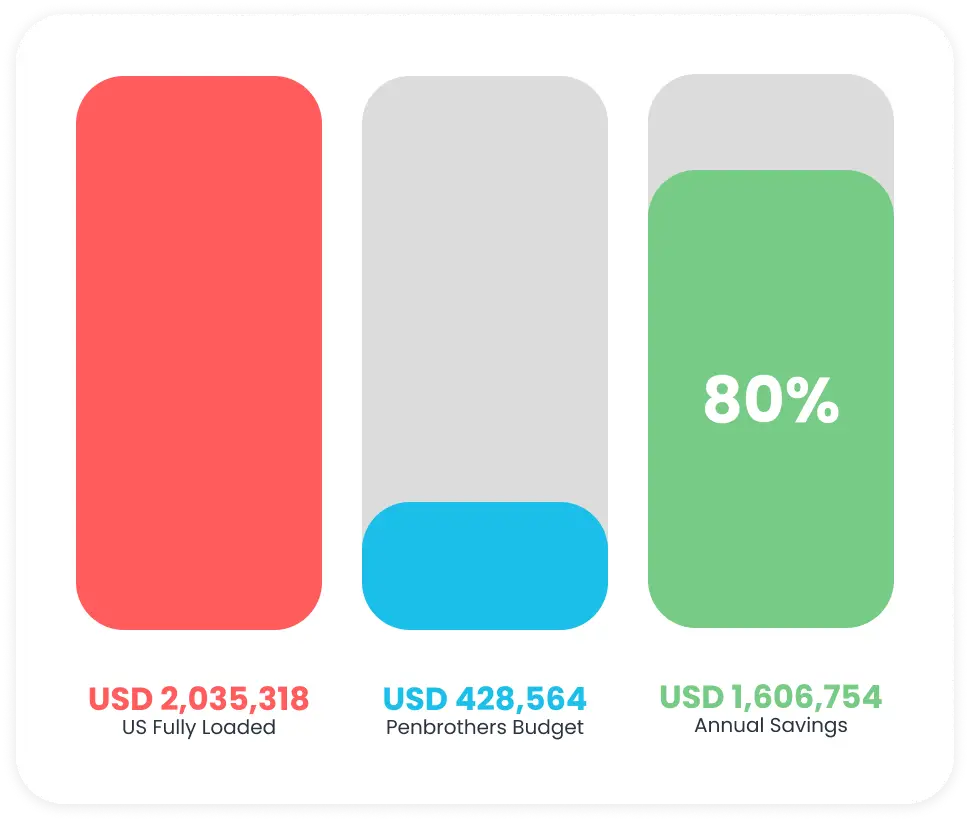
As a result, Servantex achieved an astounding 79% reduction in staffing costs per role while enhancing operational efficiency through 24-hour business coverage. Jane Hamilton, Chief Administrative Officer at Servantex, commended the Penbrothers team for their swift adaptation to the company’s processes and culture. This successful collaboration not only enabled Servantex to scale operations and optimize workforce management but also showcased the significant advantages of leveraging Filipino talent.
Embracing Offshore Staffing for Future Success
As U.S. staffing firms navigate the complexities of a competitive market, offshore talent solutions present a compelling opportunity. By embracing this model, organizations can enhance their operational capabilities, reduce costs, and access diverse talent.
If you’re ready to explore the advantages of offshore staffing for U.S. companies, consider partnering with a trusted provider like Penbrothers. Evaluate your current staffing strategies, and think about how offshore solutions could benefit your organization.
Join the growing number of staffing firms that are scaling smartly, ensuring they not only meet demand but exceed client expectations.
The future of staffing is here, and it’s global. Don’t let your firm fall behind in this rapidly evolving landscape.
Embrace offshore staffing today and position your organization for sustainable growth and success!
Related: Hiring Offshore Staff in the Philippines: Benefits, Risks & Roadmap
Frequently Asked Questions (FAQs)
Offshore staffing helps firms manage talent shortages, reduce hiring costs, and respond quickly to fluctuating client demand. It also eases pressure caused by high turnover and long time-to-hire cycles.
No. While cost savings remain important, offshore staffing is now used to access specialized skills, improve scalability, and support long-term growth strategies.
Beyond administrative roles, firms increasingly offshore IT, finance, customer support, recruitment operations, and specialized technical roles such as data and AI support.
Offshore teams allow agencies to scale faster, operate across time zones, and reduce internal workload. This results in quicker placements and more consistent service delivery.
When managed through experienced partners, offshore staffing often improves service quality by providing stable, skilled teams and round-the-clock operational support.