
Key Takeaways
- Poor customer service costs companies $3.7 trillion annually, influencing consumer spending decisions.
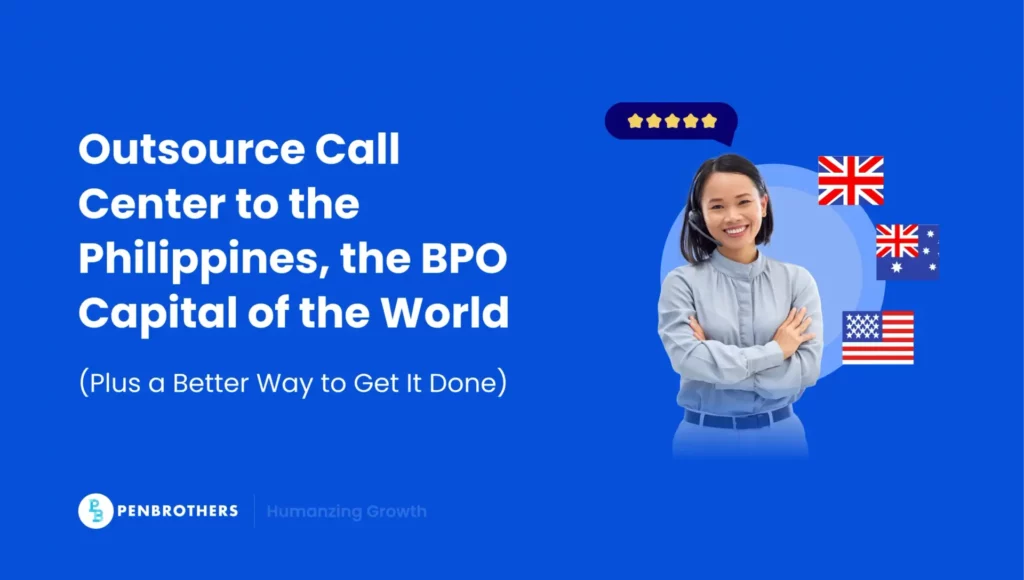
- The Philippines is the leading destination for customer service outsourcing due to emotional intelligence and cultural fluency of Filipino agents.
- Outsourcing costs in the Philippines are significantly lower compared to the U.S., with potential savings of 60-75% on salaries.
- To achieve optimal performance, companies need to choose offshoring over traditional BPO models for dedicated teams.
- Key performance indicators (KPIs) should be defined early to ensure the success of offshore customer service outsourcing.
Poor customer service costs more than most companies budget for it. An estimated $3.7 trillion in global sales is at risk annually from bad customer experiences, and 88% of consumers say customer service directly influences where they spend their money.
Outsourcing customer service to the Philippines has been the default for global companies since the country became the call center capital of the world in 2010. The case for it is well-established. What is less discussed is why so many offshore programs still underperform, and what the ones that work actually do differently.
Why the Philippines, Specifically
The Philippines is not the default outsourcing destination because it is the cheapest option. Several countries are cheaper. It is the default because Filipino professionals combine technical competency with the two things that matter most in customer support: emotional intelligence and cultural fluency with Western customers.
Filipino agents are trained to read frustrated callers, de-escalate without sounding scripted, and reach resolution efficiently. English is the language of instruction in Philippine universities and the medium of professional commerce, so agents communicate in the language rather than translating through it. The Philippines ranks 28th globally and second in Asia in English proficiency.
The infrastructure behind this has been built over three decades: purpose-built facilities, redundant fiber connections, backup power systems, and a government that actively backs the sector through tax incentives. The industry employed 1.9 million people in 2025 and generated roughly $40 billion in export revenues, with targets of nearly 2 million jobs and $42 billion by 2026. The Philippines is a reliable operating environment, not just a cost play.
Filipino teams also work night shifts aligned to U.S., UK, and Australian business hours as standard practice. Overnight processing is not an add-on. It is built into how the industry operates.
What It Actually Costs to Outsource to the Philippines
The salary differential is significant. But the total cost over 12-24 months is a more useful frame when building a business case.
Salary Benchmarks
| Role | Philippines (monthly) | United States (monthly) | Estimated savings |
| Customer service representative | $800-$1,000 | $3,600-$4,400 | 60-75% |
| Technical support agent | $1,000-$1,400 | $4,200-$5,500 | 65-75% |
| Team lead / supervisor | $1,400-$2,000 | $5,500-$7,000 | 65-72% |
Hourly rates for Philippine agents generally run $6-$15, compared to $25-$65 for U.S.-based agents. The annual fully loaded cost of an in-house U.S. call center agent, including salary, benefits, space, equipment, and management overhead, typically exceeds $70,000. Outsourcing to the Philippines can bring that to around $26,000 per agent annually.
For a more precise estimate based on your specific roles and headcount, use the Penbrothers Offshore Salary Calculator.
Regional Pricing Within the Philippines
Location within the Philippines affects cost. Manila-based agents earn 10-15% more than those in Cebu or Davao due to urban cost-of-living differences. Provincial hubs including Clark, Iloilo, and Bacolod can reduce operational costs by around 15% without a meaningful drop in English proficiency or service standards. If cost optimization is a priority, ask providers whether regional delivery is an option for your scope.
The Real Reason Offshore Call Center Programs Fail
The cost savings are real. The failure rate is also real. The gap between the two usually comes down to one structural decision made early: choosing a traditional BPO arrangement when the business actually needed an offshoring model.
Traditional BPO outsourcing means contracting a third-party provider to manage your customer service. They hire the agents, run the training, set the processes, and report outcomes to you. You define the scope and review the metrics. Day-to-day, you have limited visibility into how work gets done, enforcing your brand standards is difficult, and the team’s primary allegiance is to the BPO provider, not your company. When an agent leaves, you often don’t find out until the coverage gap shows up in your queue.
Offshoring means building a dedicated team in the Philippines that works exclusively for your business, follows your processes, and is onboarded into your standards and culture from day one. You retain control over who gets hired, how they are trained, and how performance is managed. The team builds institutional knowledge about your product, your customers, and your escalation paths. That knowledge compounds over time rather than resetting with each contract cycle.
| Traditional BPO | Offshoring | |
| Control over training | Low | High |
| Brand alignment | Inconsistent | Embedded |
| Agent loyalty | To the BPO | To your company |
| Cost structure | Lower upfront | Lower long-term |
| Best for | Overflow, short-term volume | Ongoing, embedded support |
| Data security controls | Harder to enforce | Easier to control |
For any company building a customer support function that needs to perform consistently over time, offshoring delivers more than BPO does at comparable or lower total cost once ramp expenses are amortized.
Penbrothers’ model sits firmly in the offshoring camp. Rather than operating as a traditional BPO, the approach is to help companies hire dedicated Filipino professionals who integrate directly into their teams, with a 6-month Hypercare framework that supports onboarding, engagement, and early performance from day one to day 180.
Choosing the Right Call Center Model for Your Operation
The Philippines supports several call center structures. The right one depends on your support volume, channel mix, and how much process control your business requires.
Inbound centers handle incoming customer contacts: support requests, account inquiries, technical troubleshooting. Primary metrics are resolution speed and first-contact resolution rate.
Outbound centers make proactive calls for sales, lead qualification, surveys, or appointment scheduling. Metrics center on contact rate and conversion.
Blended centers handle both inbound and outbound volume. Most Philippine providers operate blended centers, which gives flexibility as workload shifts between periods.
Omnichannel centers provide unified support across phone, email, live chat, and social media. Agent context carries across channels, so customers do not repeat their history when switching. Research on omnichannel behavior shows that customers frequently use multiple channels in a single service interaction, and unified handling improves resolution rates.
Virtual centers use agents working remotely rather than from a centralized facility. This model draws from a broader talent pool including lower-cost provincial regions, and carries lower infrastructure overhead.
Automated centers layer AI and workflow automation onto human teams to handle high-volume, repetitive contacts: balance inquiries, order status, scheduling. Agents handle escalations and complex cases. The right automation layer reduces cost per contact on routine issues without compromising the customer experience on ones that require judgment.
For most B2B companies, a blended or omnichannel model with an offshoring structure is the combination that delivers consistent performance without sacrificing control.
How to Choose a Partner in the Philippines
Most provider evaluation mistakes happen because buyers compare prices before asking operational questions. These are the criteria that actually predict performance over a 12-24 month engagement.
Industry experience. A provider that has run healthcare accounts understands compliance sensitivity. One with financial services experience understands the communication standards those clients expect. Ask for case studies in your specific sector, not general BPO credentials.
Recruitment timeline and process. Standard roles should be placed within 30 days. Ask what their sourcing process looks like for agents with specific skills, and what their replacement timeline is when someone leaves.
Training infrastructure. Ask whether onboarding is run by dedicated trainers or handed to team leads with competing responsibilities. The quality of the first 30-90 days is the single biggest predictor of attrition and performance over the following year.
Technology compatibility. Confirm integration with your CRM, ticketing system, and communication tools before signing anything. Integration friction adds cost and delays that rarely appear in initial proposals.
Data security and compliance. For healthcare, financial services, and any operation handling personal data, ask specifically about ISO certifications, encryption standards, and compliance with the Philippine Data Privacy Act and your home country’s data protection requirements.
Transparent pricing. Ask for a full cost breakdown: agent compensation, benefits, management fees, and any variable charges. A provider who bundles everything into a single monthly rate without itemization is making it harder to evaluate true cost over time. Penbrothers, for example, charges a fixed monthly management fee per employee on top of staff compensation, with no hidden costs.
Before committing to a full team, request a 30-day scoped pilot on one function. This gives you a contained window to evaluate output accuracy, communication cadence, escalation handling, and cultural fit before scaling.
KPIs to Define Before Your Team Goes Live
The most consistent reason offshore call center programs underperform is that performance benchmarks were not documented before operations started. Set these at the contract stage, not after the first review.
| KPI | What it measures | Typical benchmark |
| First Call Resolution (FCR) | Percentage of issues resolved on first contact | 70-75% |
| Average Handling Time (AHT) | Average duration per customer interaction | Varies by product complexity |
| Customer Satisfaction (CSAT) | Post-interaction customer rating | 85% or above |
| Service Level Agreement (SLA) | Calls answered within target time | 80% within 20 seconds |
| Agent attrition rate | Monthly staff turnover | Under 5% monthly |
Review all five monthly reports for the first quarter. Treat the first 90 days as calibration, not evaluation, and adjust targets based on actual baseline data before flagging variance as underperformance.
What to Outsource and What to Keep In-House
Not every customer interaction should move offshore. The right division of labor is what determines whether your customers notice the difference.
Well-suited for offshore call center teams:
- Tier 1 inbound support: account inquiries, order status, standard troubleshooting
- Outbound surveys, follow-up calls, and appointment confirmations
- Live chat and email support
- After-hours and weekend coverage
Keep closer to home:
- Tier 3 escalations involving legal, regulatory, or executive decisions
- High-value relationship management for enterprise accounts
- Crisis communications or situations with reputational risk
- Any interaction requiring real-time access to systems that cannot be securely extended offshore
The working principle is the same one that applies to any outsourcing decision: offshore execution, keep judgment calls in-house.
Building Your Offshore Customer Support Team: A Practical Sequence
Once you have selected a partner, setup follows a predictable order. Skipping steps in this sequence is where most programs create problems that they spend months undoing.
- Define your support goals. Volume, channels, hours of coverage, escalation paths, and the specific customer outcomes you are optimizing for.
- Select your partner using the criteria above. Confirm references, credentials, and a pilot scope before signing.
- Calculate headcount and total budget. Account for agent compensation, management fees, technology, and a realistic 30-90 day ramp period.
- Align on tools and system access. Confirm CRM integration, communication platform access, and reporting dashboards before recruiting starts.
- Build your own onboarding materials. Your brand standards, product knowledge, and escalation protocols need to come from you, not the provider.
- Set KPIs before day one. Use the table above. Do not wait for the first performance review to establish what good looks like.
- Run a scoped pilot. Start with one channel or function, measure against your benchmarks, and expand based on results.
- Build continuity documentation. Cross-train agents, document processes, and plan backup coverage for peak periods and unexpected gaps.
A strong offshoring partner covers HR, payroll, compliance, and engagement throughout the engagement. If those responsibilities fall back on you, that is a service model gap worth addressing before it becomes a retention problem.
Where to Go From Here
The Philippines has the talent depth, infrastructure, and operating history to support a call center program that actually performs. Whether that requires a traditional BPO arrangement or a dedicated offshore team depends on how much control your operation requires and how long you plan to run it.
For most B2B companies building a support function that needs to scale reliably, an offshoring model outperforms BPO on total cost, consistency, and staff retention over a two-year horizon. Talk to us about building a dedicated customer support team in the Philippines.
Frequently Asked Questions
The Philippines built its BPO sector over three decades, establishing the first outsourced contact center in 1992 and overtaking India as the largest call center hub by 2010. In 2025, the industry employed 1.9 million workers and generated $40 billion in export revenues, supported by a large English-speaking workforce and active government investment in the sector.
BPO outsourcing means contracting a third-party provider to manage your customer service, giving you limited control over day-to-day operations, training, and staff loyalty. Offshoring means building a dedicated team in the Philippines that works exclusively for your company, follows your processes, and is onboarded into your culture. For ongoing support operations, offshoring delivers more consistent output, tighter data controls, and lower long-term cost.
The Philippines has a Data Privacy Act (Republic Act 10173) that aligns with international data protection standards. When evaluating providers, confirm ISO certification, data encryption practices, role-based access controls, and contractual compliance with your home country’s requirements such as GDPR or HIPAA. Include data handling provisions in your service agreement before operations begin.
Filipino call center agents typically earn $800 to $1,000 per month. U.S. customer service representatives earn $3,600 to $4,400 per month for comparable roles. Total annual cost per agent, fully loaded, runs around $26,000 in the Philippines versus more than $70,000 in the U.S. Use the Penbrothers Salary Guide to calculate costs for specific roles.