
Key Takeaways
- Talent shortages drive offshoring: Nearly one‑third of occupations in Australia remain in shortage, and two‑thirds of business leaders report workforce constraints. Offshore teams fill high‑skill gaps quickly.
- Cost savings fuel growth: Salary comparisons show 70–90 % savings across administrative and professional roles. These savings free capital for innovation, product development and market expansion.
- High‑value roles, not just call centres: Offshoring has shifted from basic support to specialised roles in technology, finance, creative services, healthcare and professional services. Philippine teams often include software engineers, geospatial specialists, accountants and UX designers.
- Mature and skilled workforce: The Philippine outsourcing industry dates back to 1992 and boasts high English proficiency (EF EPI score 569, rank 28). This ensures cultural alignment and quality output.
- Hundreds of Australian firms already participate: According to the Philippine ambassador, more than 300 Australian organisations employ around 44 000 Filipino professionals. The trend is accelerating across all sectors.
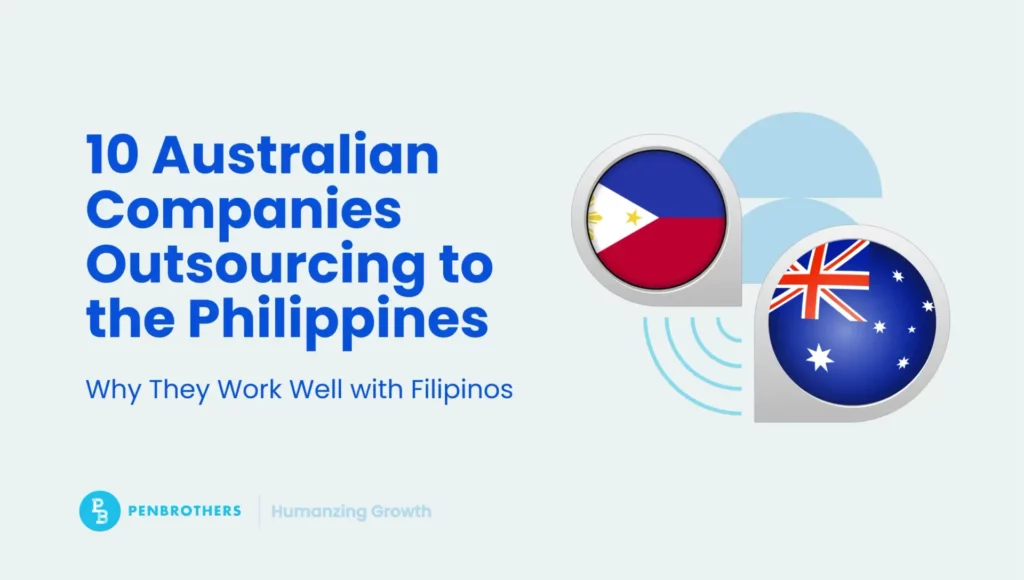
Australia’s employers face a structural talent shortage. Jobs & Skills Australia’s 2025 Occupation Shortage List reports that 29 % of assessed occupations remain in shortage, and industry leaders say two‑thirds of businesses still struggle to find skilled workers. As wages and compliance costs rise, companies look overseas for specialised talent. This article profiles ten Australian firms that have successfully built teams in the Philippines and explains how you can do the same.
Australia’s Talent Shortage Crisis Demands New Solutions
The 2025 Occupation Shortage List (OSL) from Jobs and Skills Australia (JSA) confirms that 29% of assessed occupations are officially in shortage, a figure that is only a slight easing from 33% in 2024. Australia’s skills gap remains severe. The 2025 Occupation Shortage List finds that 29 % of occupations are in shortage and shortages are driven more by a lack of qualified applicants than by sheer volume. While skills shortages have eased slightly, they remain persistent across high‑skill sectors. The Australian Industry Group reports that workforce shortages dropped from 75 % to 66 % of businesses between 2024 and 2025, yet high‑skill gaps remain acute.. As a result, salaries continue to rise and local recruitment timelines stretch beyond 90 days. Hiring offshore allows firms to access specialised talent quickly and at a lower cost.
But here’s what makes Australia’s situation particularly sharp: we’re competing against the world’s largest economies for the same specialized talent while our population centers remain isolated by geography and time zones.
The industries hit hardest tell the story. Seventy-six percent of IT companies report skills shortages. Healthcare faces critical gaps. Professional services struggle to staff even basic functions. And the traditional solutions (higher salaries, better benefits, remote work flexibility) have reached their limits when there simply aren’t enough qualified people to go around.
Where Smart Companies Turn When Local Talent Runs Dry
Australian firms discovered a mature talent market just one or two hours ahead. The Philippines became a major outsourcing destination after Accenture established the first outsourcing contract in 1992. Government support and the Special Economic Zone Act accelerated growth, creating a workforce experienced in partnering with Western businesses. High English proficiency, ranked 28th in the world, and cultural alignment make Filipino professionals well-suited for customer‑facing and technical roles.
Smart Australian executives realized something fundamental: when local talent markets fail, winning companies don’t wait for them to recover. They build competitive advantages through strategic workforce planning that transcends borders.
10 Australian Companies That Cracked the Code
Design and Creative Services
1. DesignCrowd
DesignCrowd connects businesses to global design talent through its platform. Simple concept. Complex execution. The Melbourne-based company discovered that running a global marketplace requires more than brilliant technology; it demands exceptional customer service, financial operations, and marketing coordination across time zones.
Strategic Win: DesignCrowd achieved 78% average labor cost savings across multiple roles while scaling its operations. Their accountants save 79% compared to US costs. Customer service advisors deliver 77% savings. UI/UX designers come in at 73% below traditional rates. But the real victory wasn’t the cost reduction—it was maintaining service quality while growing their user base exponentially.
“The Philippines is packed with amazing talent, and the people are really eager to do creative work,” says Guillermo Conde, Head of Customer Support at DesignCrowd. “We’re super happy to have found a solid partner in Penbrothers.”
The Insight: Filipino teams excel at both operational and creative support functions. They understand design workflows, communicate effectively with international clients, and adapt quickly to platform changes. This dual capability—analytical and creative—makes them ideal for companies operating in the creative economy.
2. Canva
Perth-born Canva transformed how the world approaches design. Co-founder Melanie Perkins chose the Philippines because of the country’s “familial feel and creativity.” That cultural insight proved prescient as Canva scaled to over 190 million users globally.
Strategic Win: Canva leveraged Filipino creativity and familial culture for international expansion, building teams that understood both the technical and emotional aspects of design democratization.
The Insight: Cultural alignment drives long-term success over pure cost considerations. Canva’s leadership recognized that creativity thrives in environments where teams feel connected to the mission, not just the paycheck.
Marketing and Growth Accelerators
3. The LOTE Agency
This Australian marketing company faced the classic agency problem: demand spikes that strain resources and threaten client relationships. Traditional hiring couldn’t solve it. By the time you recruit, train, and onboard, the campaign window has closed.
Strategic Win: The LOTE Agency achieved 75% cost savings that enabled rapid scaling during high-demand campaign periods. More importantly, they filled critical roles in just 20 days. Their Philippine team now handles project support while in-house staff provides boots-on-the-ground client service.
“The speed of hiring and quality of the talents enable us to keep delivering top-notch service to our clients and communities,” says Chief Operating Officer Brad McCaig. “We see Penbrothers as a growth partner for many more years to come.”
The Insight: Offshore teams become force multipliers during critical business moments. They provide surge capacity that traditional hiring models can’t match, allowing agencies to accept larger projects without risking delivery quality.
4. Linktree
The link management platform reached 50 million users worldwide by solving a simple problem elegantly. But elegant solutions require complex customer support as users discover creative applications the founders never imagined.
Strategic Win: Philippine teams deliver customer service excellence at scale, handling the intricate questions that arise when millions of creators use your platform in unexpected ways.
The Insight: Following Canva’s successful model, Australian tech companies discovered that Filipino teams understand the nuances of creative tools and can guide users through complex workflows with patience and expertise.
Technical Innovation and Specialized Expertise
5. Propeller Aero
Drone technology meets enterprise software in the construction and earthworks industry. Propeller Aero raised USD 15.35 million to scale their innovative platform. But innovation means nothing without the specialized talent to implement it.
Strategic Win: Propeller Aero achieved 73% cost savings while building a team of 50 handpicked talents for hard-to-fill geospatial specialist roles. The hiring process took just 40 days, a fraction of what they’d face recruiting locally for Software Engineers, Geospatial Specialists, Quality Assurance Engineers, Data Success Specialists, and GIS Specialists.
“We highly recommend Penbrothers to any company seeking to hire outstanding Filipino talent and work with a trusted partner who is committed to their success,” says Chantelle Cassin, Talent Acquisition Manager at Propeller Aero.
The Insight: Access to specialized technical talent unavailable locally becomes a competitive advantage. While competitors struggled to hire geospatial specialists in Australia’s tight labor market, Propeller Aero built a team of experts in the Philippines.
6. Employment Hero
HR solutions for SMEs across Australia and New Zealand. Employment Hero recently acquired Employment Innovations to expand their reach. Growth creates a beautiful problem: your customer service demands scale faster than your hiring capacity.
Strategic Win: Employment Hero scaled customer service to match their expanding app portfolio. Their Filipino team guides users through onboarding and troubleshoots complex HR scenarios across multiple applications.
The Insight: Offshore teams enable product expansion without operational bottlenecks. As Employment Hero added new services and acquired companies, their Philippine team absorbed the increased support volume seamlessly.
Financial Services and Professional Support
7. Macquarie
This global financial services provider operates across 33 markets and employs 16,000 people. Macquarie ranked first in the Institutional Investor’s 2024 Asia Pacific Regional Broker Rankings. When you’re managing assets and advising clients worldwide, you need technical expertise around the clock.
Strategic Win: Macquarie delegates both technical and non-technical financial work to Filipino teams, enabling 24/7 operations and specialized analysis that supports their client-facing professionals.
The Insight: Even major financial institutions rely on Philippine expertise. The days when offshore teams handled only basic back-office functions are over. Today’s Filipino professionals perform complex financial analysis, risk assessment, and client research.
8. Ascender HCM (now Dayforce)
HR and payroll platforms for multinational businesses require deep understanding of local regulations and cultural nuances. After Ceridian’s acquisition, Ascender evolved into Dayforce, expanding its global reach.
Strategic Win: Their Philippine team provides regional customer base coverage and enables local market entry throughout the Asia-Pacific region.
The Insight: Offshore teams create strategic footholds in new markets. Ascender’s Manila presence allowed them to serve Philippine companies while supporting their broader regional expansion strategy.
Related: Payroll Outsourcing Services: A Strategic Guide
Healthcare and Safety Innovation
9. SafetyCulture
Workplace safety and compliance platform serving companies worldwide. SafetyCulture joined Trackhouse Racing’s partnership lineup, demonstrating its commitment to safety across industries.
Strategic Win: SafetyCulture’s Manila office serves as its hub for business analysis and customer service, combining local presence with global expertise.
The Insight: Physical presence amplifies virtual team effectiveness. Having a Manila office allowed SafetyCulture to blend the benefits of offshore cost structures with local market knowledge and deeper cultural integration.
10. Eucalyptus
A healthcare accessibility and convenience platform making medical services more approachable for patients, Eucalyptus recently planned an $8 million share sale for long-term employees, showing their commitment to sustainable growth.
Strategic Win: Enhanced patient support and internal process optimization through Filipino teams trained in healthcare protocols and patient communication.
The Insight: Healthcare companies find Filipino teams excel at patient-centric service. The cultural emphasis on care, respect, and family translates naturally to healthcare environments where empathy matters as much as efficiency.
Related:
- Outsourcing to the Philippines: The Business Case, Costs, and Risks Decision-Makers Should Model
- How to Hire a Geospatial Supervisor for Remote and Hybrid Teams
How to Follow Their Lead: A 2025 Implementation Guide
Assessment and Planning Phase
Start with honesty. Brutal, uncomfortable honesty about where your talent gaps really hurt.
Map every role that’s been open longer than 90 days. Document the specialized skills you can’t find locally. Count the projects delayed because you lack capacity. This isn’t about cutting costs (though you will). This is about identifying where talent scarcity is strangling growth, where empty desks are costing you market opportunities, and where the competition is moving faster because they solved problems you’re still wrestling with.
Your skills gap analysis should answer three questions: Which roles are impossible to fill locally? Which functions could scale 3x if you had the right people? Where are you saying no to opportunities because you lack bandwidth?
Propeller Aero discovered its geospatial specialists were the bottleneck preventing client expansion. DesignCrowd realized customer service delays were damaging their marketplace reputation. The LOTE Agency understood they were turning down campaigns because they couldn’t staff them. Clear problems. Clear solutions.
Role prioritization follows a simple matrix. High impact, low local availability goes first. Customer-facing positions that require cultural alignment come next. Highly specialized technical roles that demand specific expertise follow. Basic administrative functions can wait, though the cost savings often justify moving them early.
Vendor evaluation gets messy fast without criteria. Look for three things: proven experience with companies your size, deep understanding of your industry requirements, and infrastructure that supports long-term partnership rather than transactional relationships. The cheapest option usually costs the most in hidden problems, delayed timelines, and quality issues that damage your brand.
Execution Best Practices
Phase one proves the concept. Start small. Pick one role or function where success is measurable and visible. Employment Hero began with customer service because response times are trackable. DesignCrowd started with financial operations because accuracy is binary. Choose something that will either work spectacularly or fail quickly.
Measure everything that matters. Response times, quality scores, project completion rates, customer satisfaction metrics. Track the learning curve. Document communication challenges. Note cultural integration successes and failures. This data shapes phase two expansion and prevents you from scaling problems instead of solutions.
Phase two builds momentum. Add complementary roles that work alongside your initial team. If customer service succeeds, add technical support. If financial operations work, expand to procurement or HR administration. The goal is creating cohesive offshore departments, not scattered individual contributors who struggle to collaborate.
Success metrics vary by function, but certain KPIs appear consistently across winning implementations. Time-to-productivity measures how quickly new team members contribute value. Quality scores track whether offshore work meets your standards. Retention rates indicate cultural fit and job satisfaction. Communication effectiveness shows how well teams collaborate across time zones.
The companies that fail make predictable mistakes. They treat offshore teams as vendors instead of employees, creating us-versus-them dynamics that poison collaboration. They under-invest in cultural integration, assuming professional competence equals cultural fit. They rush expansion before proving the model works, scaling problems instead of solutions.
SafetyCulture avoided these pitfalls by establishing its Manila office as a strategic hub, not a cost center. Canva invested heavily in cultural alignment from day one. Propeller Aero measured success by business impact, not cost savings alone.
The smart companies also prepare for success. They plan expansion before they need it, establish communication protocols that work across cultures, and build career development paths that keep top performers engaged long-term.
Because here’s what the successful companies discovered: building an offshore team that works is hard. Building one that transforms your business is harder. But once you get it right, the competitive advantage becomes almost impossible for your competitors to match.
What Are the Five Australian Industries Most Likely to Outsource Jobs?
The strategic shift from basic call center work to specialized knowledge process outsourcing (KPO) means Australian companies are now outsourcing core functions across their most dynamic sectors. While the article highlights specific firms, the broader market trend shows five major industries consistently turning to the Philippines for talent:
1. Technology and IT Services
Australian tech companies—from large firms like Atlassian to mid-sized FinTech startups—are locked in a fierce domestic battle for developers, QA engineers, and cybersecurity specialists. The Philippine talent pool provides an immediate solution for roles in Software Engineering, Cloud Computing, and Data Analytics.
2. Financial Services and Accounting (FinTech)
This industry requires complex, non-voice roles such as Bookkeepers, Chartered Accountants, Payroll Specialists, and Anti-Money Laundering (AML) analysts. The Philippines produces thousands of globally certified accounting graduates yearly, allowing Australian firms to staff high-compliance roles efficiently.
3. Creative Services and Digital Marketing
Following the lead of companies like Canva, firms seek out specialized digital talent, including UX/UI Designers, Content Writers, SEO Specialists, and Digital Campaign Managers. The combination of high English proficiency and inherent creativity makes this a perfect fit.
4. Healthcare and Medical Support
With critical shortages in local healthcare, Australian providers are outsourcing back-office medical processes that require specialized knowledge, such as Medical Transcription, Patient Billing, Claims Processing, and Telehealth Support. This allows local nurses and doctors to focus on front-line patient care.
5. Professional and Administrative Services
This category covers the foundational, high-volume roles essential for Australian SMEs and growing enterprises: Executive Assistants, Virtual Receptionists, HR Administrators, and Recruitment Support. Outsourcing these roles frees up internal teams to focus on strategic local growth.
Strategic Staffing vs. BPO: Who Is the Philippines Recruitment Agency for Australia?
The article’s case studies (Canva, Propeller Aero, DesignCrowd) highlight a key distinction: they are not using traditional Business Process Outsourcing (BPO) call centers. They are using a strategic staffing model—the core offering of Penbrothers.
Understanding the Difference: BPO vs. Strategic Staffing
| Model | Primary Focus | Team Structure | Typical Roles |
| Traditional BPO | Process and Cost Reduction | Employees work for the BPO vendor, often on shift rotation, handling basic tasks. | Call Center Agent, Basic Data Entry |
| Strategic Staffing | Talent Access and Scalability | Employees work for you as dedicated, integrated members of your team, often in high-value roles. | Software Engineer, Data Analyst, Financial Analyst, Creative Director |
The Strategic Staffing Partner
While many agencies recruit for Australia, Penbrothers is positioned as a strategic staffing partner that provides a complete, integrated workforce solution, not just recruitment. This model is built on:
- The Hypercare Framework: This proprietary 180-day onboarding system is designed to accelerate productivity, minimize early failure risk, and achieve long-term retention—a crucial differentiator from transactional recruiting.
- Cultural Fit: We pre-vet candidates not only for technical skill (the 1% who pass our assessment) but also for cultural fit with Australian management styles, ensuring seamless integration with your onshore team.
- Talent, Not Transactions: The goal is to build long-term, specialized departments, which is why top Australian firms delegate complex roles like Geospatial Specialists and Quality Assurance Engineers.
Related page: Hire a Case Manager Who Turns Service Gaps into Results
The playbook is clear. The case studies are proven. The question becomes execution.
DesignCrowd didn’t achieve 78% cost savings by accident. The LOTE Agency didn’t scale its operations in 20 days by luck. Propeller Aero didn’t hire 50 specialized geospatial experts overnight because the stars aligned. Each discovered what hundreds of Australian companies now understand: the right strategic partner transforms offshore hiring from a cost-cutting exercise into a competitive advantage.
But here’s what separates the winners from the wishful thinkers. Success doesn’t come from finding the cheapest labor or the fastest hiring. It comes from finding the partner who understands that your offshore team isn’t a vendor relationship—it’s an extension of your business, aligned with your culture, committed to your outcomes, integrated into your vision for growth.
The companies featured in this analysis chose partners who deliver more than talent placement. They chose partners who provide the infrastructure, legal compliance, cultural integration, and ongoing support that turns offshore hiring into offshore success. They chose partners who understand Australian business culture while maintaining deep expertise in Philippine talent markets and employment law.
Most importantly, they chose partners who think strategically about workforce planning, who see offshore teams as solutions to talent shortage rather than substitutes for local hiring, who position international talent acquisition as a pathway to market expansion and operational resilience rather than a desperate response to rising costs.
If you’re ready to follow their lead, the path forward is straightforward. Start with a conversation about your specific talent challenges, your growth objectives, and your timeline for implementation. Discuss the roles that could transform your business if filled with the right expertise. Explore how strategic offshore partnerships could accelerate your market position while building the operational flexibility that keeps you competitive regardless of what economic disruption comes next.
Contact Penbrothers today to begin the strategic workforce planning that transformed these ten Australian companies and positioned them for sustained competitive advantage in an increasingly global marketplace.
Frequently Asked Questions
Australia faces persistent high‑skill shortages—29 % of occupations are currently in shortage, and two‑thirds of business leaders still report workforce constraints. The Philippines offers a mature talent market with high English proficiency and cultural alignment. Offshoring enables firms to access specialised skills quickly and at lower cost.
Outsourced roles have moved far beyond call centres. Australian firms now hire Filipino software engineers, geospatial specialists, accountants, payroll analysts, marketing managers, customer service advisors, and medical support staff. These high‑value roles address gaps across technology, finance, creative services, healthcare and professional services.
Savings vary by role and company, but independent salary benchmarks show 70–90 % savings across administrative, professional and technical roles. For instance, a virtual assistant may cost AUD 11 000 per year in the Philippines versus AUD 59 000 in Australia. These savings can be reinvested in product development and growth initiatives.
Quality depends on the partner and integration. The Philippines has been a BPO leader since 1992, and many professionals have decades of experience working with Western clients. High English proficiency and cultural compatibility make it easier to maintain quality standards. The key is to treat offshore staff as part of the team, provide structured onboarding and measure performance.
A common mistake is viewing offshore teams as transactional vendors rather than integrated employees. This leads to poor communication and high attrition. Successful companies invest in cultural alignment, clear metrics and long‑term career paths. Starting small, measuring results and scaling intentionally reduces risk.